
“Then you really might know what it’s like,
Then you really might know what it’s like,
Then you really might know what it’s like to have to lose.”
We first met the equally gifted and cursed Will Graham in Thomas Harris’ 1981 novel, Red Dragon, the best-seller that also introduced us to Dr. Hannibal Lecter. Outside of our imaginations, however, it would be almost five years before we would see the purposeful-looking profiler in flesh and blood on screen in Michael Mann’s Manhunter (1986), and another 16 before his last theatrical appearance in Red Dragon (2002).
From the novel, and subsequent films, we understood Graham to possess the uncomfortable and unwelcome talent of pure empathy, an ability to assume the point of view of brutal killers. While it was an ability that allowed him to translate evidence in a way that others simply could not, Harris’ words informed us of the toll it took on Graham, but it was a phenomenon that we’d never truly witnessed on-screen.
Until Bryan Fuller resurrected the Lecter universe with NBC’s groundbreaking Hannibal series in 2013.
Do you see?
After more than thirty-one years, two films and a novel, we were finally given the opportunity to truly observe Will Graham for the first time through the brilliant vehicle that is Hugh Dancy.
Prior to the opening scene of the program’s initial episode, we’d only been offered glimpses of what Graham could conjure through his unique imagination. Be it with William Petersen talking himself through the thought process in Manhunter, or the briefest of visions presented through the lens of Edward Norton’s reluctant voyeur, we never truly delved into Will Graham’s mind.
Hannibal set about changing that, and while this writer will be the first to say that Mads Mikkelsen’s Lecter is the finest portrayal of the cannibalistic caretaker, the reason that the television series soared for 39 episodes was the presentation of Will Graham.
As Damian Swift and Mark Shannon were the first to achieve the feat of penning Jason Voorhees (Derek Mears) as not only human, but human being with Friday the 13th (2009), Fuller and company allowed a similar peek behind the curtain. Graham was no longer an edgy, hesitant hero with hundreds of thousands of miles on his engine, but for the first time, the price of Graham’s gift was put on full display.
Dancy’s exhibition of Graham was closer to self-diagnosed Asperger’s and autism than a jaded veteran detective. Interaction was not just difficult, but strained and stressful. Not once was there an I-told-you-so revelation that altered the approach to a case, but rather a sad, reserved interpretation of “the ugliest thoughts in the world.”
The beauty of Hannibal, and of Dancy’s portrayal, was another line from Everlast’s “What it’s Like,” – “God forbid you ever had to walk a mile in his shoes” — a lyric that applied not only to Graham, allowing himself into the headspace of a psychopath, but to the audience that embarked on that same journey through Graham’s eyes.
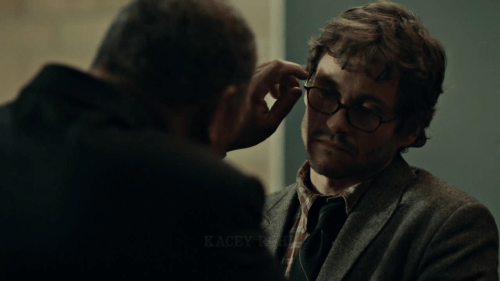 And Fuller’s Hannibal wasted no time in communicating that we weren’t in Kansas anymore.
That first view found Graham analyzing the surroundings of a crime scene, then rewinding to the very moment he’d summoned the courage to kick the door in and experience the heinous thoughts, actions and sentiments of the perpetrator.
Graham entered the home with confidence, and upon putting down Mr. Marlow (Wayne Downer), emphatically declared “He will die watching me take what is his away from him. This is my design.” Next, he shot Mrs. Marlow (Bernadette Couture) “expertly through the neck,” paralyzing her before she hit the floor, setting up the first true indication that this was not the Will Graham we’d thought we known over the course of three decades.
Graham slowly walked toward the downed victim and said “which doesn’t mean that she can’t feel pain,” his eyes searching for the words, Dancy whispered a tormented “It just means,” before continuing “she can’t do anything about it.”
The empathy of Graham not only allowed him to adopt unwanted points of view, he also empathized with the victim, and the awful thoughts and visions running through his mind.
Graham would go on to point out that the work Jack Crawford (Laurence Fishburne) had recruited him to do was “not good for (him),” as we laid eyes upon the incredibly expensive emotional, psychological and physical tax of Graham’s imagination.
Hannibal’s Will Graham was not a damaged, yet contented family man who didn’t want to look anymore, he was unstable and fractured long before he stepped foot inside the Marlow home. A fragile tea cup whose crevices were sure to weaken every time he opened his eyes. Or closed them.
And it was Dancy who made each new fissure at once agonizing and exquisite, in a beautiful turn that if we’re honest about it, is the very reason fans continue to clamor for a fourth season, almost three years after Hannibal was taken off the air.
Because of Hugh Dancy, there is still a desire, dare I say a need, to borrow Will Graham’s imagination.
Discover more from Nightmare Nostalgia
Subscribe to get the latest posts sent to your email.

Beautiful article.
I wanted to point out that you accidentally wrote “Darcy” twice instead of “Dancy” in some paragraphs.
LikeLike