All posts by Landon Evanson

Sight Unseen — The Lasting Images of Henry: Portrait of a Serial Killer

Tobe Hooper once said “I don’t believe in using too much graphic violence, although I’ve done it. It’s better to be suggestive and to allow the viewer to fill in the blanks with their minds.” The Texas Chainsaw Massacre (1974) is not one of the finest horror experiences ever put to film because of on-screen slaughter, but rather the suggestion of bloodshed. The long-lasting effect of Hooper’s direction was borne from the simple presentation of a scenario, the resulting (and very personal) nightmares were conjured entirely within the headspace of whomever laid eyes on it.

The concept isn’t exclusive to TCM, but certainly applies to John McNaughton’s tense tale of a week in the life of a sociopath, 1986’s Henry: Portrait of a Serial Killer. Though it made its way around film festivals for years, the Motion Picture Association of America’s inability, or unwillingness to give it a straight R-rating delayed its limited theatrical release for 4 years.

As legendary film critic Roger Ebert noted, however, “This film deserves to be seen,” and over the course of more than three decades, it has become essential viewing for horror aficionados everywhere. And not for overt violence, although like Hooper, it had its fair share, but rather for what wasn’t seen.

Make no mistake, the reasons for suggestion in this case were partially due to budgetary and time constraints. However, McNaughton wanted to truly explore the inner workings of Henry’s (Michael Rooker) mind, as well as his relationship with Otis (Tom Towles) and Becky (Tracy Arnold), which meant that on-screen violence would have to be dispersed carefully, but to offer a true glimpse at the danger housed within the protagonist, the film would need to be littered with other misdeeds.

And that is where the power of suggestion entered the equation, in part through the utilization of brilliant music cues strewn throughout by film editor Elena Maganini. Portrait of a Serial Killer’s main theme is composed of the simplistic yet powerful piano chords of Ken Hale, Steven A. Jones and Robert McNaugton that matched Rooker’s icy glare, begging the question, what truly resided beneath the surface.

The horrors left in Henry’s wake were revealed through a series of pan shots, offering a peek behind a veneer that should never come into focus. Again, the issues of budget and time factored into McNaughton’s decision-making, yes, but ultimately the road followed was that which would make the greatest impact, and that avenue was paved by sound editor Cory Coken and post-production sound mixer Ric Coken. The audible screams of victims blended with Henry’s angry commands to “shup up!” underneath ghastly visuals painted a picture that turned blood cold, as viewers were burdened with whatever terror played before their mind’s eye thanks to the macabre melody dancing through their heads.

All which set up McNaughton’s final stroke of genius.

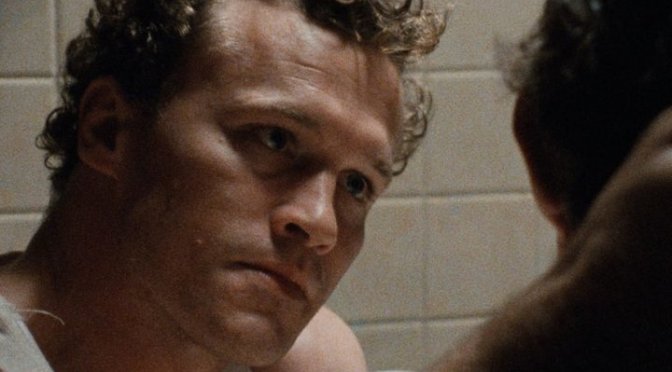
BeckyAfter Henry returned to the apartment to find Otis raping his sister, and the ensuing scuffle that resulted in Otis’ death, Henry’s instinct took over and he dismembered his friend’s body in the bathtub before hitting the road with Becky.

In a wink to the audience, another music cue foretold Becky’s fate, as “Loving you was my mistake” sprang from the radio before the pair reached their roadside motel.

The following morning, pulling to the side of a desolate road in the middle of nowhere, Henry exited his vehicle and waited for cars to pass before he opened the trunk. When it had reached its apex, it was accompanied with a single, ominous piano chord. To that point, there may have been hope that Becky had already been in the car when the vehicle pulled away from the motel, but in that moment, the audience knew.

Henry waited for another car to pass, then glanced over his shoulder to ensure no others were coming, lifted Becky’s blue suitcase, now her tomb, and laid it at the top of a ditch beside his car. Once again, the terrified shrieks of one of Henry’s victims echoed as the luggage connected with the earth below. McNaughton had cinematographer Charlie Lieberman hold the shot, and slowly zoom to the blood-smeared bag, a grotesque exclamation point on a film that has always carried an unsettling tinge of documentary.

As Henry pulled away and the camera closed in, all that was left were the curdling chords of Henry’s theme, and the remains of the one person it appeared Henry may have had the slightest sentiment for. Uncaptured and unpunished, the sounds perfectly encapsulated the unknown of where Henry, or those like him—who unquestionably exist—would head next.

The visceral images of McNaughton’s masterpiece proved too much for many audience members to endure when it first reared its head at film festivals decades ago, and abandoned it to what Ebert described as “the purgatory between [an] R and X [rating].” The film was too powerful and too well done to be contained for long, but for the violence we witnessed, including the devastatingly difficult to digest home invasion segment, it was the intonations left unseen that made Portrait of a Serial Killer so indelible.

They were haunting in 1986, and haunting today.

Henry luggage

You Just Can’t Keep a Good Guy Down: Why the Child’s Play Franchise is Anything but Stale

All honesty, I’ve never been one for rebuttals when it comes to writing about horror. I respect the opinions of others and understand that we won’t all see eye-to-eye very often, if at all. Who’s to say who’s right and who’s wrong?

However, a recent article from 1428 Elm wondered whether the Child’s Play franchise was not only spreading itself thin, but if it was in danger of getting stale.

I cannot abide. So here we go.

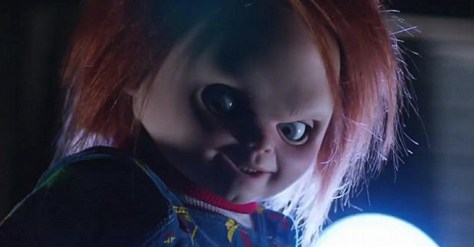
Having recently spoken with Child’s Play 2’s (1990) Christine Elise, she used a phrase that struck me, “Don Mancini’s empire.” Though I had never thought of it quite so succinctly, it’s no less true, because it is Mancini who drives the franchise, not Chucky, he’s merely the vehicle.

The man not only created this universe we all know and love, but has written all seven installments, directed the last three, acted as executive producer for Bride of Chucky (1998), and as of this writing, is slated to, at the very least produce the television series.
Child's Play TV seriesAt a glance, it would appear that seven features and an upcoming TV project may appear to be a bit much, maybe even spread thin, but not when you consider that the original film hit theatres in 1988, and we have seen gaps of seven, six, nine and four years from Child’s Play 3 (1991) to the most recent effort, Cult of Chucky (2017).

What’s more, the last two films are the very reason Wade Wainio’s assertions are askew.

Mancini has always possessed perfect pitch when it comes to his franchise, not only in tone and atmosphere, but with what is or is not resonating with the fans. After Child’s Play 3, Mancini felt as though he was beginning to tell the same story over and over, and believed it was time to switch things up. And he was right, 3 didn’t have the same energy as the first two, which led to that first seven-year hiatus. Mancini made the decision to fully embrace the badboy one-liners and humor inherent in his demonic doll, and gave us the thoroughly enjoyable popcorn horror thrill ride that was Bride. And the fans loved it. That Jennifer Tilly entered the equation as Tiffany didn’t hurt one bit because Mancini realized that the time had come to give Chucky a wing-man, or wing-woman as it were. And make no mistake, Tiffany is adored by Child’s Play fans, so that particular call was a stroke of genius. And it wouldn’t be the last.

When Mancini attempted to build on the final frame of Bride with Seed of Chucky (2004), it seemed to fall flat, at least in this writer’s estimation, but as previously stated, I could be wrong, I’m sure there are many who dig the fifth film. That said, the injection of a humor focus worked for Bride, but not so much for Seed, so Mancini again took his time before unleashing the next chapter.

Nine years later, we would find Chucky venturing back to his darker roots with Curse of Chucky (2013), and though we would get our first glimpse of a new Mancini trick – the end credits tease – it wasn’t the hint of Andy’s (Alex Vincent) return that made the film, but rather the introduction of a new character, Nica Pierce. Beyond the rare slasher trait of continuity, something that has always set the Child’s Play franchise apart is the sense of family, not only on-screen, but off. Those who have built this “Mancini empire” truly appear to be a tight-knit group, and what could be more familial than casting Brad Dourif’s daughter to play the human lead? And as we all know, Ms. Dourif didn’t just get the part because she’s Brad’s offspring, she has added layers of vulnerability, strength, emotion and depth that has elevated the entire franchise.
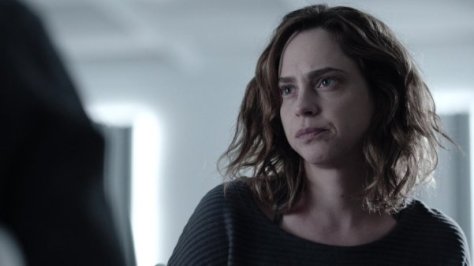
Fiona DourifFrom Curse, the most recent foray was with Cult last year, and pound-for-pound, it may be Mancini’s finest effort yet. Not only was Chucky at his hilariously villainous best, he is now legion, complete with Hannibal references that warm the heart. Fiona again delivered a sensational performance, Tilly was involved, Tiffany made an appearance, and of course, Andy is back in the fold. The story was strong, the writing spot on, it had creative kills, and despite a clinical setting, it was visually pleasing, and the climax had fans aching for what’s next.

Truly think about that last statement. We are talking about a franchise’s seventh film. Typically with such scenarios, we’re off the rails, numerous writers and directors have veered so far from the original vision that it’s almost, if not completely laughable. But Child’s Play is not Hellraiser or Friday the 13th or Children of the Corn, because it’s always had Mancini.

The final few minutes of Cult were eye-bulgingly fantastic. Chucky’s chant finally worked, and when Nica rose from her wheelchair and Ms. Dourif gifted us one of the most spot-on mimics in cinematic history, we felt chills. What is Chucky going to do in that body? Where is he going to go? What awaits down the road?

Fiona as Chucky walked out into the snow to Tilly while Andy was stuck in a cell, most likely to be framed for the slaughterhouse inside the mental health facility, to say nothing of the small army of Good Guy dolls ready to wreak havoc at Nica / Chucky’s command.

The fun didn’t end there, however, because Mancini had one last face-breaking smile left in his bag of tricks. He sent a friend to pay a visit to Chucky’s head, left at Andy’s secluded cabin, and when the sliding door opened and Kyle (Elise) walked in, you could almost hear the squeals of delight from every corner of the country.
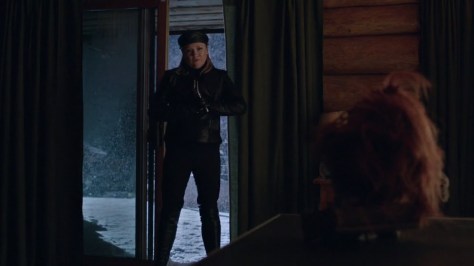
Kyle CultEvents, intriguing events, that will lead into the television series, and perhaps the next feature, whenever that might be.

When a franchise spreads itself thin, over-saturation is almost always the culprit. A new movie, shoddily pieced together to make a deadline focused less on quality than a cash grab. And if a television series were to be a thing, it would usually fall sometime during the height of its run, not more than three decades after it began.

Thirty years and seven movies on, that is where the Child’s Play franchise stands. It’s not only alive and well and thriving, but almost incomprehensibly improving the further it wanders from the night we met Charles Lee Ray.

And that’s as far from stale as it gets.
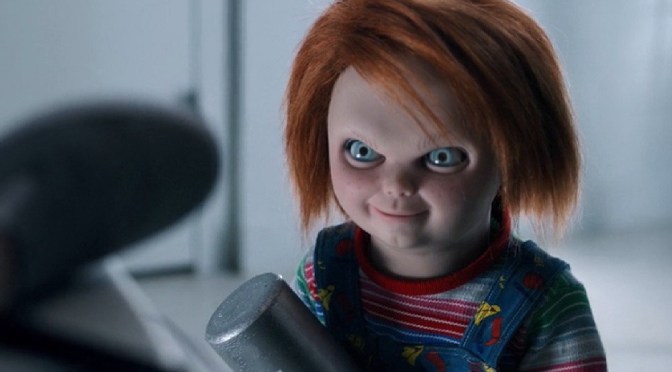
Chucky

Ya-Bang: Vinny Guastaferro Reflects on the Legacy of Jason Lives

“One of the great, great things about horror movies is that because there’s almost, I don’t want to use the words ‘cult following,’ but a fanatic fan base, they last forever.”

Jason Lives: Friday the 13th Part VI hit theatres on August 1, 1986, and three decades on, it’s a film that has not only demonstrated the staying power Vinny Guastaferro described, but seems to be gaining in popularity with each passing year. To mark the 32nd anniversary of Jason Voorhees’ resurrection, Guastaferro shared some memories of one the most popular, and certainly most unique chapters in franchise history.

Guastaferro came to the role of Deputy Rick Colone after being cast in Bullpen, a baseball play that revolved around the “banter between the pitchers” in the bullpen of a New York Yankees / Boston Red Sox contest that was directed by Tom McLoughlin.

The mastermind behind Friday’s sixth chapter, “like a lot of people in Hollywood,” shared with Guastaferro that “I just got a job doing a big movie and I’d like you to be in the movie,” the Jason Lives writer and director told the man who would go on to be Colone, “but it’s for Paramount Pictures and you have to audition and everything.”

Guastaferro didn’t mind the specter of an audition because “fighting for a role is part of what an actor is inured to.” It wasn’t until Guastaferro read the script, however, that he became excited for a “terrific role,” because he would be playing a cop with “a singular agenda,” itching to shoot somebody or something, who was “kind of the comic relief and the asshole all at once.”

McLoughlin loved Guastaferro’s take on the character, as would the fans. The rest, as they say, is history.

The overwhelming fan response to Deputy Rick from the Friday faithful was a bit foreign to Guastaferro at first. He wondered if some of the fans were a bit crazy, what with couples waking around conventions with two-year olds in strollers, others with his lines tattooed on body parts, and stories of 10-year olds watching with their parents. But the more exposure he had to horror aficionados, the more Guastaferro came to realize that it was all about the love of Jason Lives being handed down from generation-to-generation.

“I actually came to appreciate the fans and the fanaticism for these movies a little bit later because I just did [Jason Lives] as a movie and said ‘I hope it’s good,’ and it was good.” Guastaferro admits to being “a little prejudiced” when saying that he believes Part VI to be “the best of the whole franchise,” but legions of fans back up that assertion. “Look, I know people who are fanatic about this movie who are still under 10 years old, and I know people that are fanatics about this movie that are about 65 or 70 years old.”

That a horror flick filmed in Georgia three decades back has enjoyed an almost incomprehensible shelf life is humbling to Guastaferro.

“It’s been a privilege to be in a movie that has had this kind of recognition for this many years. People still email me and Facebook me and call me Rick and deputy, and they quote my lines. Pretty amazing to me.”

The affable New Jersey native is very humorous by nature, and wasted no time noting that one of those lines that gets quoted constantly has been more rewarding than the wife he got out of the production.

You read right.

Red dotGuastaferro had been dating Cynthia Kania, who along with Roger Rose was brought in to play Annette following principle photography to be double-skewered on a motor scooter to ensure McLoughlin reached the picture’s death quota. And when asked which ranked higher, landing the line or the spouse, Guastaferro didn’t hesitate.

“Ohhh, having one of the most memorable lines, I was gonna get that wife no matter what,” Guastaferro shot back. “I had met her a little earlier, and I had dated her, but definitely having the line. Are you kidding?! ‘Wherever the red dot goes, ya-bang!’ is something that I get in the mail, I get people sending me photos with that written on it, I had a woman in Vienna (Austria) show up at one of the horror cons I did over there, and she had that line tattooed on her fucking arm!”

“I think having the line is probably the most rewarding thing ever,” Guastaferro said. “I mean, I was watching Predator the other night, and I love the line (adopting an Ahnold accent) ‘If it bleeds, we can kill it.’ And I thought, ‘Yeah! I own one of those lines!’ I’m really happy to have that (laughs).”

It was a line Guastaferro came up with himself, exclaiming “Ya-bang!” when McLoughlin presented him with the hand cannon and scope that would be used in the cemetery scene, a benefit of the trust established through his previous project with McLoughlin. “Tom gave me a lot of leeway in there, and I invented some of the lines and improvised and he decided to keep them because he wanted the character to be revealed as partly a jerk, and funny.”

The line (and the decision to keep it) was inspired, because with the fans, all these decades later, the red dot still hits the target.

“I’ve been to conventions where people have asked me to write it on their ass, on their bald head with a permanent marker, on their cleavage. Girls would come in with crop tops on and have me write ‘Wherever the red dot goes, ya-bang!’ right across [the small of their back].”

For those scoring at home, Guastaferro and Kania were married a month after they wrapped on Jason Lives, but the legacy of “ya-bang!” isn’t lost on Guastaferro.

“I felt good every night knowing that the audience was leaving touched by what I did (on stage), but it’s nowhere near as rewarding as knowing that there are friggin’ five million people out there who were enamored of Friday the 13th,” Guastaferro reflected.

“Listen, every actor wants to know that what they did had some kind of impact on people,” Guastaferro said. After more than 50 films, 100 television appearances and extensive theatre performances, it hasn’t been the dramatic roles with social messages that have endured, but a horror film from 1986.

“It’s not deep, it’s not meaningful, it’s not about social cause or change, it’s entertainment. And that’s what Tom wanted it to be.”

Guastaferro referred to Jason Lives as “the king of my movies,” and continued, “I am so pleased, I’m so pleased. One of my proudest movies is Friday the 13th.

Ted White, who portrayed Jason in The Final Chapter, is apt to say “Always leave them wanting more,” a sentiment echoed by Guastaferro. “Smile and laugh, that’s what we want.”

It’s been 32 years since Deputy Rick Colone unholstered his sidearm. We’re still smiling, and still laughing.

Guastaferro