Category Archives: Editorials

Sight Unseen — The Lasting Images of Henry: Portrait of a Serial Killer

Tobe Hooper once said “I don’t believe in using too much graphic violence, although I’ve done it. It’s better to be suggestive and to allow the viewer to fill in the blanks with their minds.” The Texas Chainsaw Massacre (1974) is not one of the finest horror experiences ever put to film because of on-screen slaughter, but rather the suggestion of bloodshed. The long-lasting effect of Hooper’s direction was borne from the simple presentation of a scenario, the resulting (and very personal) nightmares were conjured entirely within the headspace of whomever laid eyes on it.

The concept isn’t exclusive to TCM, but certainly applies to John McNaughton’s tense tale of a week in the life of a sociopath, 1986’s Henry: Portrait of a Serial Killer. Though it made its way around film festivals for years, the Motion Picture Association of America’s inability, or unwillingness to give it a straight R-rating delayed its limited theatrical release for 4 years.

As legendary film critic Roger Ebert noted, however, “This film deserves to be seen,” and over the course of more than three decades, it has become essential viewing for horror aficionados everywhere. And not for overt violence, although like Hooper, it had its fair share, but rather for what wasn’t seen.

Make no mistake, the reasons for suggestion in this case were partially due to budgetary and time constraints. However, McNaughton wanted to truly explore the inner workings of Henry’s (Michael Rooker) mind, as well as his relationship with Otis (Tom Towles) and Becky (Tracy Arnold), which meant that on-screen violence would have to be dispersed carefully, but to offer a true glimpse at the danger housed within the protagonist, the film would need to be littered with other misdeeds.

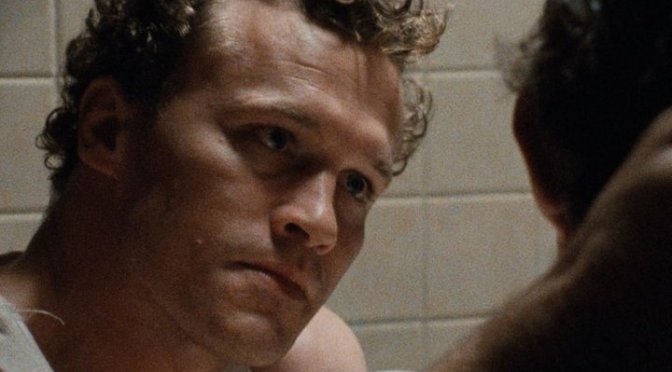
And that is where the power of suggestion entered the equation, in part through the utilization of brilliant music cues strewn throughout by film editor Elena Maganini. Portrait of a Serial Killer’s main theme is composed of the simplistic yet powerful piano chords of Ken Hale, Steven A. Jones and Robert McNaugton that matched Rooker’s icy glare, begging the question, what truly resided beneath the surface.

The horrors left in Henry’s wake were revealed through a series of pan shots, offering a peek behind a veneer that should never come into focus. Again, the issues of budget and time factored into McNaughton’s decision-making, yes, but ultimately the road followed was that which would make the greatest impact, and that avenue was paved by sound editor Cory Coken and post-production sound mixer Ric Coken. The audible screams of victims blended with Henry’s angry commands to “shup up!” underneath ghastly visuals painted a picture that turned blood cold, as viewers were burdened with whatever terror played before their mind’s eye thanks to the macabre melody dancing through their heads.

All which set up McNaughton’s final stroke of genius.

BeckyAfter Henry returned to the apartment to find Otis raping his sister, and the ensuing scuffle that resulted in Otis’ death, Henry’s instinct took over and he dismembered his friend’s body in the bathtub before hitting the road with Becky.

In a wink to the audience, another music cue foretold Becky’s fate, as “Loving you was my mistake” sprang from the radio before the pair reached their roadside motel.

The following morning, pulling to the side of a desolate road in the middle of nowhere, Henry exited his vehicle and waited for cars to pass before he opened the trunk. When it had reached its apex, it was accompanied with a single, ominous piano chord. To that point, there may have been hope that Becky had already been in the car when the vehicle pulled away from the motel, but in that moment, the audience knew.

Henry waited for another car to pass, then glanced over his shoulder to ensure no others were coming, lifted Becky’s blue suitcase, now her tomb, and laid it at the top of a ditch beside his car. Once again, the terrified shrieks of one of Henry’s victims echoed as the luggage connected with the earth below. McNaughton had cinematographer Charlie Lieberman hold the shot, and slowly zoom to the blood-smeared bag, a grotesque exclamation point on a film that has always carried an unsettling tinge of documentary.

As Henry pulled away and the camera closed in, all that was left were the curdling chords of Henry’s theme, and the remains of the one person it appeared Henry may have had the slightest sentiment for. Uncaptured and unpunished, the sounds perfectly encapsulated the unknown of where Henry, or those like him—who unquestionably exist—would head next.

The visceral images of McNaughton’s masterpiece proved too much for many audience members to endure when it first reared its head at film festivals decades ago, and abandoned it to what Ebert described as “the purgatory between [an] R and X [rating].” The film was too powerful and too well done to be contained for long, but for the violence we witnessed, including the devastatingly difficult to digest home invasion segment, it was the intonations left unseen that made Portrait of a Serial Killer so indelible.

They were haunting in 1986, and haunting today.

Henry luggage

You Just Can’t Keep a Good Guy Down: Why the Child’s Play Franchise is Anything but Stale

All honesty, I’ve never been one for rebuttals when it comes to writing about horror. I respect the opinions of others and understand that we won’t all see eye-to-eye very often, if at all. Who’s to say who’s right and who’s wrong?

However, a recent article from 1428 Elm wondered whether the Child’s Play franchise was not only spreading itself thin, but if it was in danger of getting stale.

I cannot abide. So here we go.

Having recently spoken with Child’s Play 2’s (1990) Christine Elise, she used a phrase that struck me, “Don Mancini’s empire.” Though I had never thought of it quite so succinctly, it’s no less true, because it is Mancini who drives the franchise, not Chucky, he’s merely the vehicle.

The man not only created this universe we all know and love, but has written all seven installments, directed the last three, acted as executive producer for Bride of Chucky (1998), and as of this writing, is slated to, at the very least produce the television series.

Child's Play TV seriesAt a glance, it would appear that seven features and an upcoming TV project may appear to be a bit much, maybe even spread thin, but not when you consider that the original film hit theatres in 1988, and we have seen gaps of seven, six, nine and four years from Child’s Play 3 (1991) to the most recent effort, Cult of Chucky (2017).
What’s more, the last two films are the very reason Wade Wainio’s assertions are askew.

Mancini has always possessed perfect pitch when it comes to his franchise, not only in tone and atmosphere, but with what is or is not resonating with the fans. After Child’s Play 3, Mancini felt as though he was beginning to tell the same story over and over, and believed it was time to switch things up. And he was right, 3 didn’t have the same energy as the first two, which led to that first seven-year hiatus. Mancini made the decision to fully embrace the badboy one-liners and humor inherent in his demonic doll, and gave us the thoroughly enjoyable popcorn horror thrill ride that was Bride. And the fans loved it. That Jennifer Tilly entered the equation as Tiffany didn’t hurt one bit because Mancini realized that the time had come to give Chucky a wing-man, or wing-woman as it were. And make no mistake, Tiffany is adored by Child’s Play fans, so that particular call was a stroke of genius. And it wouldn’t be the last.

When Mancini attempted to build on the final frame of Bride with Seed of Chucky (2004), it seemed to fall flat, at least in this writer’s estimation, but as previously stated, I could be wrong, I’m sure there are many who dig the fifth film. That said, the injection of a humor focus worked for Bride, but not so much for Seed, so Mancini again took his time before unleashing the next chapter.

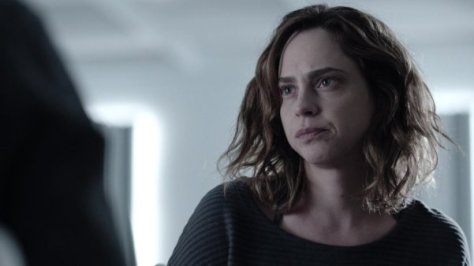
Nine years later, we would find Chucky venturing back to his darker roots with Curse of Chucky (2013), and though we would get our first glimpse of a new Mancini trick – the end credits tease – it wasn’t the hint of Andy’s (Alex Vincent) return that made the film, but rather the introduction of a new character, Nica Pierce. Beyond the rare slasher trait of continuity, something that has always set the Child’s Play franchise apart is the sense of family, not only on-screen, but off. Those who have built this “Mancini empire” truly appear to be a tight-knit group, and what could be more familial than casting Brad Dourif’s daughter to play the human lead? And as we all know, Ms. Dourif didn’t just get the part because she’s Brad’s offspring, she has added layers of vulnerability, strength, emotion and depth that has elevated the entire franchise.

Fiona DourifFrom Curse, the most recent foray was with Cult last year, and pound-for-pound, it may be Mancini’s finest effort yet. Not only was Chucky at his hilariously villainous best, he is now legion, complete with Hannibal references that warm the heart. Fiona again delivered a sensational performance, Tilly was involved, Tiffany made an appearance, and of course, Andy is back in the fold. The story was strong, the writing spot on, it had creative kills, and despite a clinical setting, it was visually pleasing, and the climax had fans aching for what’s next.
Truly think about that last statement. We are talking about a franchise’s seventh film. Typically with such scenarios, we’re off the rails, numerous writers and directors have veered so far from the original vision that it’s almost, if not completely laughable. But Child’s Play is not Hellraiser or Friday the 13th or Children of the Corn, because it’s always had Mancini.

The final few minutes of Cult were eye-bulgingly fantastic. Chucky’s chant finally worked, and when Nica rose from her wheelchair and Ms. Dourif gifted us one of the most spot-on mimics in cinematic history, we felt chills. What is Chucky going to do in that body? Where is he going to go? What awaits down the road?

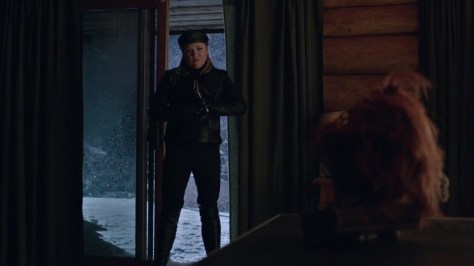
Fiona as Chucky walked out into the snow to Tilly while Andy was stuck in a cell, most likely to be framed for the slaughterhouse inside the mental health facility, to say nothing of the small army of Good Guy dolls ready to wreak havoc at Nica / Chucky’s command.

The fun didn’t end there, however, because Mancini had one last face-breaking smile left in his bag of tricks. He sent a friend to pay a visit to Chucky’s head, left at Andy’s secluded cabin, and when the sliding door opened and Kyle (Elise) walked in, you could almost hear the squeals of delight from every corner of the country.

Kyle CultEvents, intriguing events, that will lead into the television series, and perhaps the next feature, whenever that might be.
When a franchise spreads itself thin, over-saturation is almost always the culprit. A new movie, shoddily pieced together to make a deadline focused less on quality than a cash grab. And if a television series were to be a thing, it would usually fall sometime during the height of its run, not more than three decades after it began.

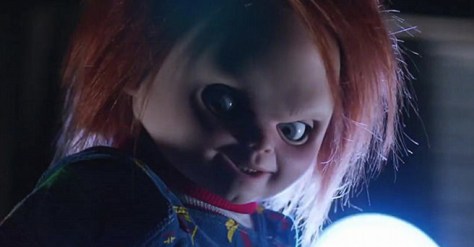
Thirty years and seven movies on, that is where the Child’s Play franchise stands. It’s not only alive and well and thriving, but almost incomprehensibly improving the further it wanders from the night we met Charles Lee Ray.

And that’s as far from stale as it gets.

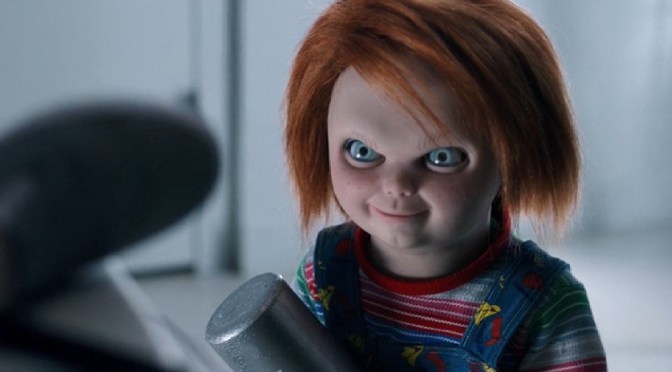
Chucky

Underrated Slashers Presents, Frank Zito of ‘MANIAC!’

Horror takes many shapes and assumes various forms in order to affect us. Be it monsters, killers, or simple catastrophes, horror is there to incarnate both our deepest fears and our darkest sense of humor. By far, the Slasher Genre is my favorite kind of horror to watch, and there are hundreds to choose from out there. So much so that too many of them go overlooked and remain underrated. For that reason I, Manic Exorcism, gladly pull back the tattered veil to shed some sinister light upon these underrated slasher killers.


MANIAC (1980)

Why hello again. Come and gather around the hobo fire. Have your pick of any select hooker to scalp (they always come in plenty around this side of town), because today on Underrated Slashers we’re heading into some very sketchy places and getting extra sleazy, my little Nasties. Today we’ll be looking at one of the 80’s all-time best slasher films, William Lustig’s MANIAC!

The world of Frank Zito is a vile one indeed. One of the uncontrollable desires, lust, a cruel obsession for the flesh, and – above all else – murder. Brought to us by the larger-than-life performance of Joe Spinell , Frank Zito’s is a tale of atrocities and tragedy. A man controlled by need and ruled by his addiction. An addiction not for narcotics, no, but for something far more seductive. The addiction for perfection and beauty. The lovely victims who fall prey under his serrated knife are not innocent, at least not in his diluted sight. Afterall, they were told not to go out tonight.

The Midwest Film Journal
image via The Midwest Film Journal

The 80’s were the golden years of the Slasher Genre. Ah Hell, that decade gave birth to the genre. That was the golden age of Freddy, Jason, Leatherface and Michael Myers! When the big baddies wet the screens red with the blood of the innocent, and we fucking loved it! That’s also the decade that was pumping out slashers on nearly a weekly basis, so much so that we could barely keep up with them. Sadly, as the bigger names were given limitless sequels as their box office success rose like the smoke off a cannibal pyre, there were single films that got woefully overlooked in the great crowd of murder and mayhem. And by no means does that mean these lesser-knowns were in any way inferior. Quite the contrary, as in the case of MANIAC, often times they were either equal to or superior to the hell unleashed upon Elm Street or Crystal Lake.

rotten tomatoes
image via Rotten Tomatoes

In the case of Frank Zito, the blood was realistic and the outcome was gruesome. As a matter of fact, this may very well be one of the most unpleasant films in the genre to sit through. You can feel the humidity of this film. I swear at times you can even smell it. You get that rancid stench of neglected trash filling the undercity’s gutters, and the odor of cheap cologne mingled with heavy sweat just permeates nearly every scene. It kinda smells like Old Spice and spicy sausage with a hint of uncontrollable BO.

Make no mistake, this is a very dirty movie. Every minute of the film makes damn sure you understand that. It’s a film that makes you want to shower after watching it, and fuck it all that’s why I love it! Few movies can have that kind of an effect on an audience.

Life Between Frames
image via Life Between Frames

We do not simply watch Frank Zito’s life, we are thrust into it. We walk the darkly wet streets with him. We sit in the corner of his dingy flat, and we are up close and personal with his obscenities.

ORIGINS

Every good serial killer must have a beginning, thus keeping that ancient riddle of nature vs. nurture alive – are maniacs born or built? In Frank’s case, we learn that he was constantly abused by his prostitute mother, and honestly, there is a wide-open door left here for us to explore the psychology of a killer through studying our nasty friend, Franky.

scumcinema
image via scumcinema

So, with Freddy we have a child killer who was provoked by his alcoholic father’s sadism, in Jason, we have an innocent child who was bullied, picked on, then left to drown, but who also had an overly-loving mother who was ready and all-too-willing to kill for her beloved Jason. Frank Zito was victim to his mother’s sick perversities. Zito had no supernatural powers, but he kept New York City in a grip of scarlet terror and still proves to be just as deadly as his fellow murderers.

I’ve said it before, but really that’s the kind of killer that makes us all squirm. They live in the flat down the hall, just like Dahmer. They aren’t the type we’d want to spend an afternoon with, but we would never expect to find a hidden museum of the macabre waiting behind their locked doors.

bocadoinferno
image via bocadoinferno

And trust me – and without giving anything away – Frank has a grotesque little shrine built out of sin itself. For gorehounds, this is a film you won’t want to pass up! For slasher freaks, this is one underrated hit you have to finally see.

Recently, MANIAC has been enjoying a much-needed revival thanks to my friends over at Eibon Press. They specialize in bringing the crassness of grindhouse classics back to life with new twists and insidious depth. Their first issue of MANIAC is a must-have for any fan of the sleazy classic. And for the truest of sickies, issue 2 promises to pit Frank Zitto against the New York Ripper himself. So holy fuck! It’s a manic dream come true! To read more on the insane awesomeness of Eibon Press please click here and see what you’ve been missing in your life.

Wicked Horror
image via Wicked Horror

So there you have it, my Nasties. Frank Zito is out there in the dark corners of your world. He waits in the shadows and looks out through wild eyes of craven lust. Once he decides to strike there is no escape. So be careful when you walk away from here, and always keep your head turned towards those grimy alleyways, that parking garage you think is empty, or, if you’re really unlucky, outside your front door.