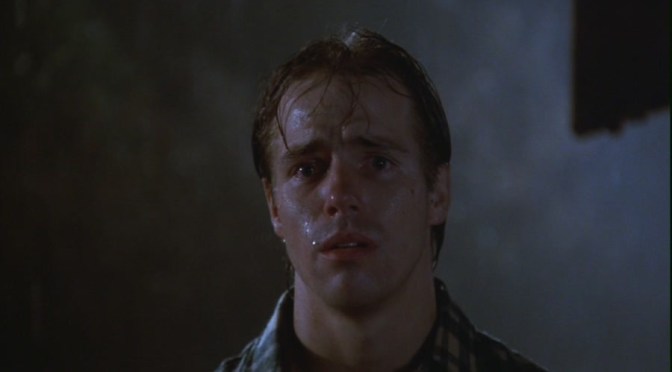
“Let’s think beyond the legend, put it in real terms.”
Only twice since Ginny Field (Amy Steel) applied her child psychology training in FRIDAY THE 13TH PART 2 (1981) has the Crystal Lake saga embraced those words: with Derek Mears in the 2009 reboot, and through John Shepherd’s performance as Tommy Jarvis in A NEW BEGINNING (1985).
Tackling a role that had already been fulfilled by other actors—particularly well-known actors—can prove a difficult endeavor, and Tommy Jarvis was no different. For John Shepherd in the fifth installment of the Friday franchise, that fact is and was compounded by a series of issues, not the least of which was timing.
To begin, Corey Feldman was not only the original, but easily the biggest name to have ever portrayed the character. Though THE FINAL CHAPTER opened in April of 1984, less than two months later Feldman would appear in the massively successful GREMLINS, which was closely followed by THE GOONIES, another blockbuster the following year. STAND BY ME hit theatres the year after that, by which time Feldman had become a household name and as a result, towers as the epitome of Tommy Jarvis in the eyes of many fans.

What’s more, a large portion of those fans regard THE FINAL CHAPTER as the finest of Friday films, whereas A NEW BEGINNING is widely viewed as nothing more than the bridge between Part IV and JASON LIVES, another beloved franchise installment that saw Thom Mathews pick up the Tommy torch, and who already enjoyed cult status for his part in RETURN OF THE LIVING DEAD (1985).
While one would be hard-pressed to claim that continuity has been a series strong suit, that Mathews’ Jarvis no longer appeared to carry any of the burdens of the trauma he’d endured as a child (or even shortly before the events of Part VI) is a point rarely contended. The fact that JASON LIVES moved at breakneck speed while also embracing the absurdity and humor inherent in the franchise not only endeared it to Friday followers, but made the latter point an easy one to forgive or forget—to say nothing of the fact that Jason wasn’t really even Jason in A NEW BEGINNING. In short, when it comes to the Jarvis trilogy, Shepherd suffered the misfortune of being bookended by a pair of actors seared into the minds of Friday fans as the Alpha and Omega because they happened to helm two of the franchise’s most popular entries.
Key factors all, and components that have relegated Shepherd’s Jarvis to Crystal Lake purgatory. However, it would be a mistake to overlook what Tommy 2.0 brought to the table.
One aspect of Shepherd’s performance that made it so spectacular was that it fittingly followed in the footsteps of Jason from the standpoint that every tortured nuance was offered with nary a word. Writers Martin Kitrosser, David Cohen and Danny Steinmann fashioned A NEW BEGINNING’s screenplay in such a way that the elements of Post-Traumatic Stress Disorder were not only on full display, but peppered throughout as though boxes to be checked off. It was in what Shepherd did with those opportunities, however, that left it feeling like anything but a laundry list put to film.
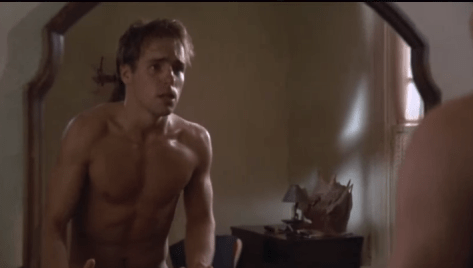 What’s more, how many performances have the Crystal Lake saga really given us? For as beloved as Betsy Palmer is, her Pamela Voorhees was over the top—for effect to be sure—but over the top, nonetheless. So we’re talking Amy Steel from Part 2 (1981) , Lar Park-Lincoln from THE NEW BLOOD (1988), and Shepherd’s Jarvis from A NEW BEGINNING. So why not celebrate it?
Our first glimpse at Shepherd as Tommy found him waking in an Unger Institute of Mental Health transport van, sweaty and wide-eyed after waking from a nightmare where Jason rose once more. Unable to shake the ghastly events that led to the death of his mother and near murder of his sister at the hands of the Crystal Lake marauder, it was a re-introduction that could have easily fallen into camp, but Shepherd played it with purpose, an effect he wouldn’t relinquish for the duration of the film’s 92-minute runtime.
We bore witness to a character drowning in the symptoms of PTSD. Shepherd’s Jarvis avoided contact and interaction with others whenever possible, and suffered unwanted and intrusive memories of Jason of both the auditory and visual variety. Recurring nightmares made sleep nearly impossible and he was easily startled by nearly everything that crossed his path. Those instances of alarm led to angry outbursts of aggressive behavior because subconscious though they were, whatever figure plagued Jarvis in the moment wasn’t Voorhees, so it served as an outlet for frustration, a punching bag that could be beaten.
True to character, though, Shepherd never ventured too far and instead stayed the course, his fright morphed to resentment and finally to anger, played in such a way that outward reaction was an involuntary response. When Tommy body-slammed Eddie (John Robert Dixon) at breakfast, he was almost immediately pinned to the wall by the head of Pinehurst, Matt (Richard Young), where Shepherd brilliantly conveyed the briefest moment of recognition. As Jarvis snapped back to reality, he glanced at Matt and closed his eyes in remorse, his chest heaving as he collected himself. Later, after he went Chuck Norris on Junior (Ron Sloan) at the trailer park, Tommy was again roused back to the present by Pam (Melanie Kinnaman) and fled at the sad, desperate realization that in those moments, he was unable to control himself.
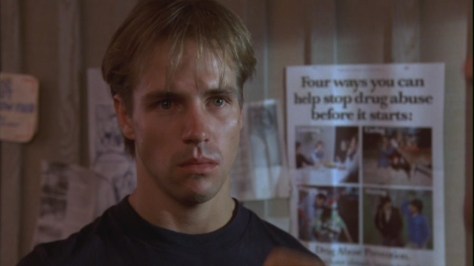 And finally, when Jarvis once more found himself standing face-to-face with “Jason,” Shepherd’s Jarvis was frozen, unable to move until threatened with his own demise. Stabbing his nemesis in the leg, he made his way to the barn loft where he lost consciousness. When he came to and laid eyes on Pam and Reggie (Shavar Ross) in imminent peril, Jarvis, as though having an out of body experience, leapt to action to protect a young woman and child in danger. Thoughts of Shepherd tearfully gazing at the photograph of his mother and sister earlier in the film flood through the audience’s collective mind as they watched Tommy, in a way, save the family he had lost, sending “Jason” / Roy (Dick Wieand) plummeting to his death.
Shepherd’s Jarvis was lost and tormented, and even when his actions were heroic, they emerged reluctantly and never escaped the fractured framework of a younger self who had seen things that could not be unseen.
With the simple decision to follow the path laid by Ginny three films prior, John Shepherd’s turn as Tommy provided FRIDAY THE 13TH more than its finest achievement of the Jarvis trilogy, but the single greatest performance the franchise has ever known.
For a series short on performance, that Shepherd thought beyond the legend and put it in real terms deserves respect, and 34 years on, it’s about time he gets it.
 Therein lies the answer to how the word “sustainable” pertains to The Last Drive-In. The