
There’s just something exceptionally satisfying about bedazzling the most “joyful” holiday of the year into a ho-ho-horror spectacle that gives me all the damn fuzzies. Christmas Horror, as we all know is entirely a subgenre on its own, churning out various titles throughout the years to keep our holidays grim and dark. From holiday horror treasures such as Black Christmas and Silent Night, Deadly Night, to more modern instant classics like Rare Exports and most recently Violent Night, have become seasonal band-aids for genre fans to get even the scroogiest of Scrooges into the Xmas spirit.
Seriously, dive into some boozy eggnog and get cheery. You don’t want to be caught on the naughty list.
The Christmas Horror movie list is ever-growing in its own glorious classification of horror, but how about some of those holiday-themed episodes from some of our favorite television shows that fit into the horror category? Much like the beloved Halloween specials we receive on occasion from all the various genres of sitcoms, (Roseanne did it best, fight me) horror-infused primetime has a good chunk of dark yuletide ammo to mix things up in between those holiday-horror feature films that are generally free to watch with certain streaming subscriptions, or hell sometimes YouTube will give it to for free!
So grab your Finger Figgy Pudding, a shot of DeadNog, and let me advise you, viewers, on some binge-worthy essential Holiday Horror TV.
“The Munsters Scary Little Christmas Special”
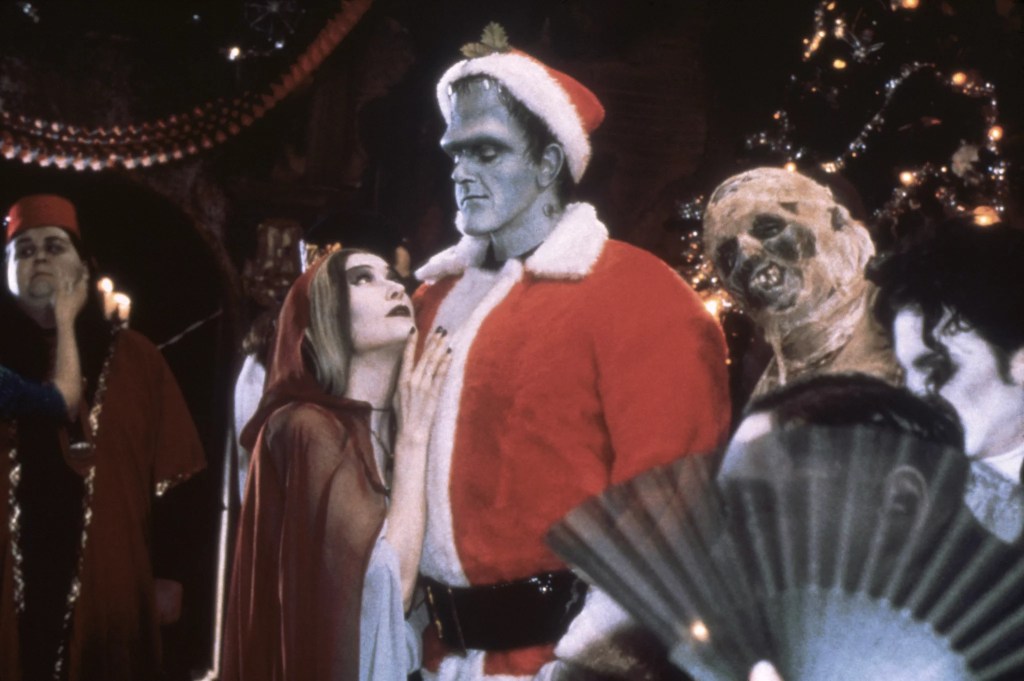
The 90-minute special that aired on CBS back on December 17, 1996, introduces an all-new cast inhabiting the mansion on Mockingbird Lane; and it’s really not as bad as one would think. Just watch Rob Zombie’s crap version of 2022 and then get back to me on this.
The basic main plot centers around little Eddie and his melancholy holiday spirit that of course, only Santa Claus can resurrect- typical Christmas story plot. However, and again, this is the Munsters, so all sorts of silly shenanigans are afoot along the way. Certainly, the coolest part is the monster party Lily throws to cheer up Eddie and his longing for his Transylvanian home. Various branches of the extended Munster family make an appearance at the holiday shindig, all of which are depicted by famous movie monsters. Oh yes, there’s a Creature from the Black Lagoon in there and it’s fan-friggin-tastic.
In the very few times The Munsters have been rebooted and recast, this little holiday special seems most true to the feel of the original ‘60s series. The makeup and Munster Mansion could look better, but those are just nitpicking details that shouldn’t sway anyone from checking this one out at least once. It’s one of my eight-year-olds and my father’s favorites, who is a die-hard, no-bologna Munster fan. So if you love the silliness from the old show, chances are you’ll get a kick out of this as well. You can rent it here on Amazon for $1.54!
“Unholy Night”– “American Horror Story: Asylum”
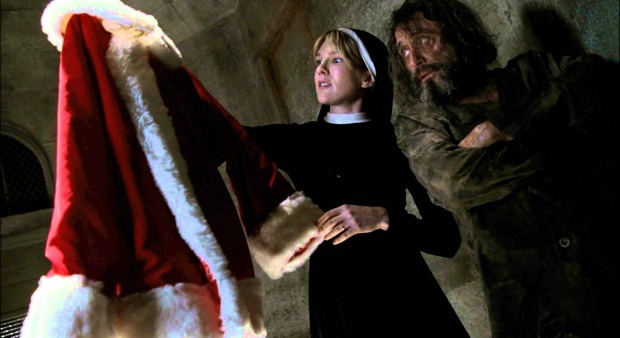
Move over Bloody Face and make room for Santa Emerson.
In season two, episode eight of Asylum, we’re introduced to a seriously disturbed, homicidal Santa with one hell of a twisted sense of humor- Leigh Emerson (Ian McShane). Emerson kills a bell-ringing Santa and unleashes a reign of terror on a preselected family. Which ultimately lands him at the infamous Briarcliff and under Sister Jude’s abusive control. Until the tables turn on her anyway.
Of all the psycho Santas in the genre, McShane’s portrayal of this Yuletide maniac is by far the most seriously underrated. This character needs his own full-length Christmas horror feature for sure. “The only difference between me and the real Santa is that he only comes once a year!”
It gets me every time.
Personally speaking, I’m not a huge fan of AHS’s second season, but “Unholy Night” certainly hits a major high note for this chapter in Murphy’s spiritually connected saga. Bonus points, this episode is written by James Wong (Final Destination) and directed by Michael Lehmann (Heathers). You can stream this one here over on Hulu.
“How the Ghosts Stole Christmas”“The X-Files”
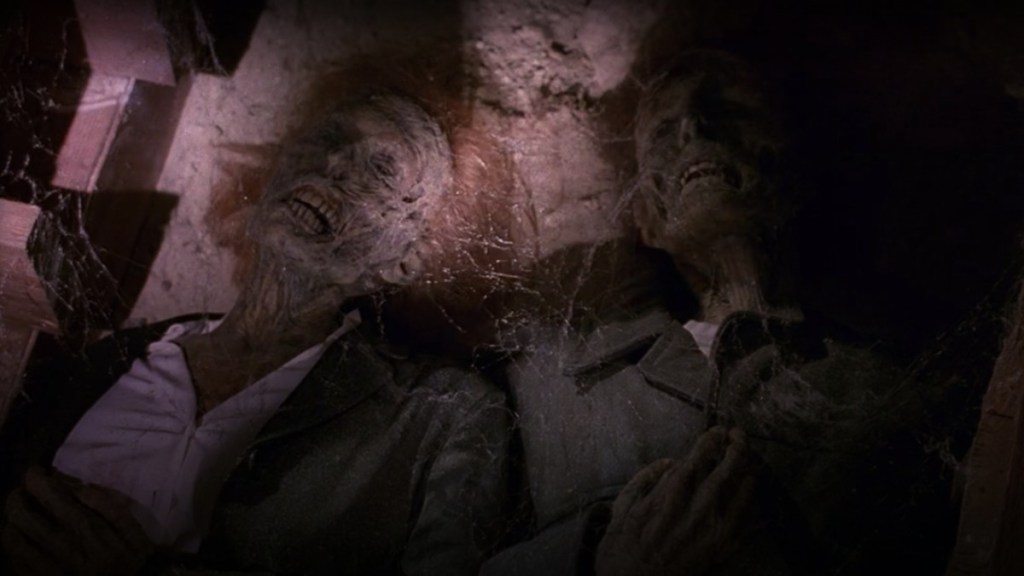
Originally airing on December 13, 1998, The X-Files sixth season brought forth a nice little Christmas episode wrapped in paranormal packaging. “How the Ghosts Stole Christmas” is one of those stand-alone monster episodes in the series that strays away from the storyline, but is welcomed nonetheless. Some of the best episodes in the series have been these types of episodes, and this one, in particular, is way up on that list folks.
The episode co-stars Ed Asner and Lily Tomlin as a pair of trickery star-crossed deceased lovers, who performed a murder/suicide pact in their home. Folklore has it that any couple who enters their abandoned house will become trapped and forced into the same fate. That sounds like a case for Mulder and Scully! What better way to spend Christmas than ghostbusting, eh?
With a fantastically dark haunted house set up on the heels of the Noel holiday, this Christmas edition of X-Files has plenty of good scares and some personal time with Mulder and Scully. Among all the paranormal illusions and corpses under the floorboard, there’s a really touching Christmas moment between the pair at the end of the episode. Ending it on a heartfelt high note. Because that’s what Christmas is all about, right? Grab your significant other and catch this one on Hulu here.
“Night of the Meek”–“The Twilight Zone”
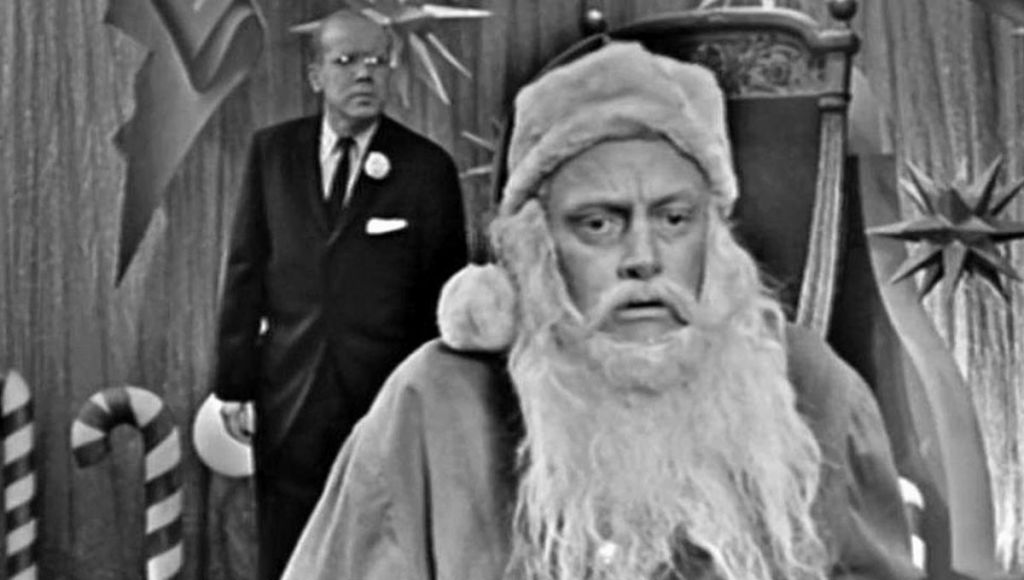
First airing on December, 23rd 1960 on the CBS primetime lineup, Twilight Zone’s “Night of the Meek” has become an annual tradition in our house of horrors. There isn’t any blood, gore, or psycho Santas swinging axes, but there’s a lot of heart and mystery here. That goes a long way.
Most episodes from The Twilight Zone offer some sort of mind-fucking twist to get you rattled a tad. However, “Night of the Meek” is one of those rare exceptions that just leaves you all fuzzy on the inside. Rod Serling takes us on a Christmas Eve journey into The Twilight Zone with a down-and-out Mall Santa, Henry Corwin. Visibly drunk and a bit disoriented, Corwin is fired from his jolly job and then goes into a pretty powerful monologue explaining why he is boozing it up for the holidays. Unable to truly bring happiness and full bellies of hungry kids as Santa, Corwin’s only Christmas wish is for the “meek to inherit the Earth.”
Well, this is The Twilight Zone. Corwin is about to get his selfless wish granted.
Nearly 60 years after its premiere, “Night of the Meek” is a true classic not just from the series as a whole, but in pop culture altogether. For a simple 30-minute TV episode to stand the test of time and manage to give you all the damn feels, is something not to be ignored in the slightest. Forget waiting for that New Year’s marathon. Watch the episode here on Paramount Plus!
“And All Through the House”– “Tales From the Crypt”
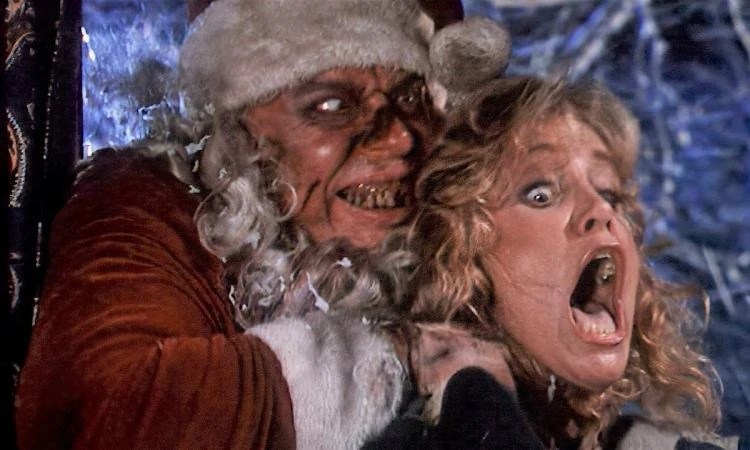
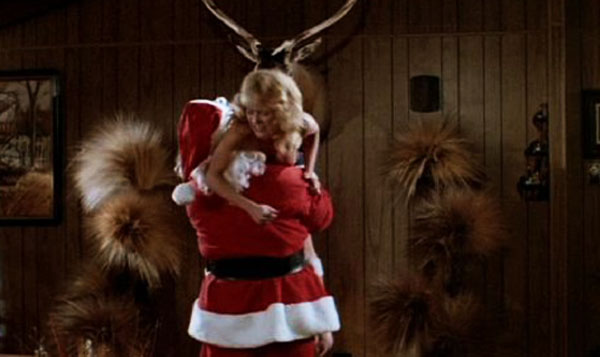
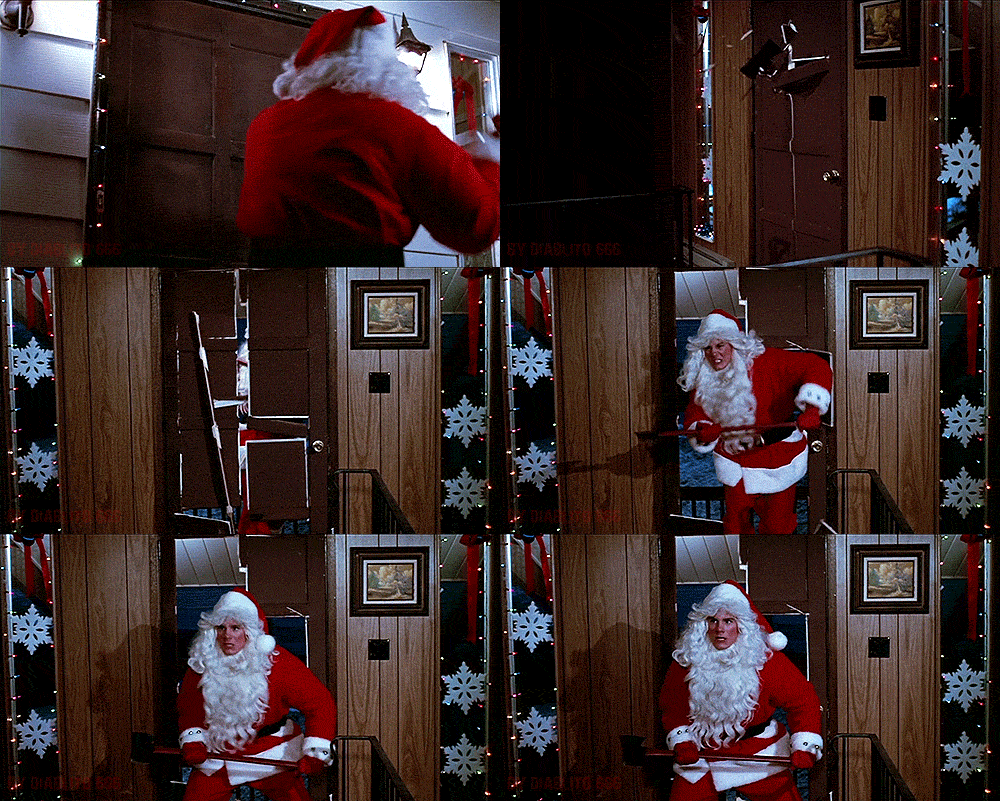
To this day, I’m not sure if there are any other televised psycho Sandy Claws that tops the Cryptkeeper’s “And All Through the House” season one episode. Heavily considered in fandom as one of the best in the series, the June 10th, 1989 premiere is taken directly from the #35 Vault of Horror EC comic. Staying true to that 1950s eerie tale in the graphic mag, Director Robert Zemeckis and Monster Squad writer Fred Dekker begin the shenanigans with an even more horrifying than usual Cryptkeeper donning a Santa mask. (I’m pretty certain that was the most terrifying visual during the entire 22 minutes.)
Writer Dekker brings in his Monster Squad actress, the late Mary Ellen Trainor to portray a greedy wife who murdered her husband on Christmas Eve to gain insurance money. All while their daughter is upstairs anxiously waiting for the arrival of Santa. Lovely, eh? Well, karma is a mighty bitch and while the housewife of the year is dumping the body in the backyard, an escaped lunatic dressed as St. Nick attacks her. She narrowly escapes back to the house, but the deranged Kris Kringle is relentless in his attempts to give her a dose of Christmas justice.
Also, worth noting, Hollywood giant in Cinematography Dean Cundey worked on this episode. In case you’re unfamiliar, Cundey has provided his directorial photography skills to various John Carpenter classics such as Big Trouble in Little China, The Thing, Halloween II, Season of The Witch, and even Jurassic Park! Just a fun little fact I didn’t want you guys to miss. Speaking of, can we please get all the seasons streaming already with our literal 10,000 different subscribed services!? It’s 2022 and the fact Tales From The Crypt can’t get a home anywhere is beyond frustrating. The licensing issues shave gone on far too long and enough is enough. So thank ghouls that we have a FREE YOUTUBE upload here courtesy of Spooky Gals Corner.
Now that’s the Spook-Mas gift we all wanted.